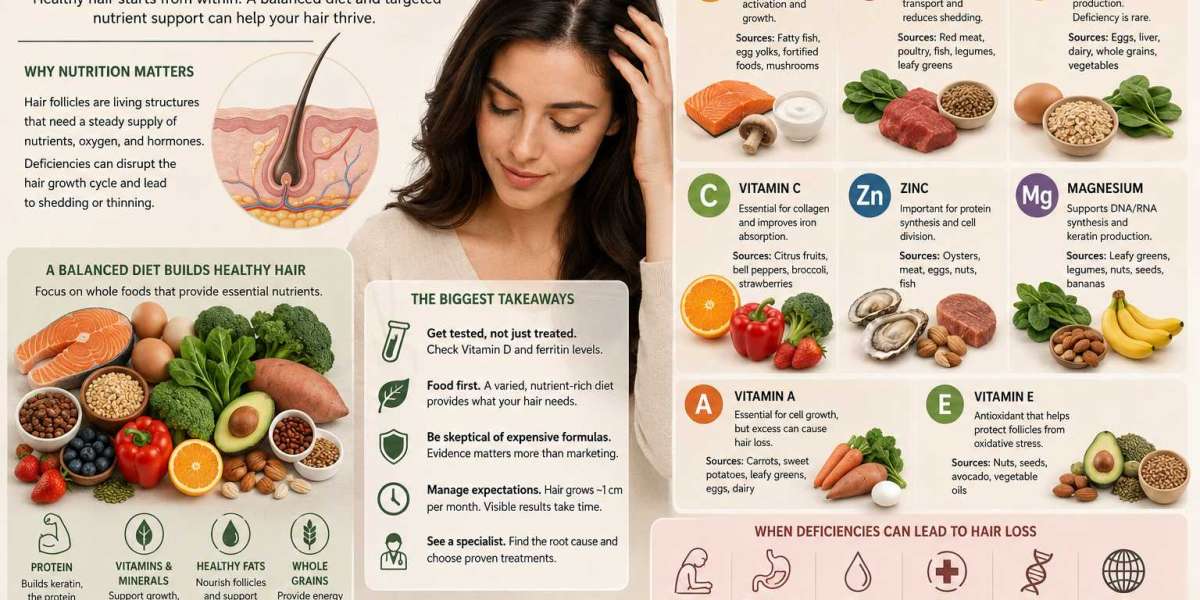

Hair loss is one of the most emotionally charged health concerns people face, and it has spawned a multi-billion-dollar supplement industry that promises lush, thick locks in exchange for a monthly subscription. Before you reach for an expensive "hair growth formula," it helps to understand what the science actually supports — and what your hair truly needs to thrive.
The short answer is this: vitamins and minerals are essential for healthy hair, but deficiencies severe enough to cause hair loss are rare in people eating a reasonably varied diet. Here is a clear-eyed look at the key nutrients, what they do, where to get them, and when supplementing actually makes sense.
Why Nutrition Matters for Hair
Each strand of hair grows from a follicle — a living structure that depends on a steady supply of nutrients, oxygen, and hormones. Hair is largely made of keratin, a structural protein, and the cells that produce it replicate faster than almost any others in the body. That rapid growth rate makes hair follicles particularly sensitive to nutritional shortfalls.
However, as leading hair loss specialists emphasize, true nutritional deficiency causing hair loss is uncommon outside of extreme diets, specific medical conditions, or undeveloped regions with limited food access. Most of us obtain everything our follicles need from food. That said, knowing which nutrients matter — and which ones you might genuinely be missing — is worthwhile for anyone concerned about hair health.
Vitamin D: The One Worth Checking
Of all the vitamins linked to hair growth, Vitamin D has among the strongest supporting evidence. It plays a role in activating hair follicles, and there are documented cases of hair regrowth after correcting a deficiency. The problem is widespread: in cloudy northern climates and among people who spend most of their time indoors, Vitamin D deficiency is extremely common.
Most experts recommend adults aim for 2,000–5,000 IU daily and get their blood levels checked at least once a year. A healthy blood level sits between 50–70 ng/ml; anything below 30 ng/ml is considered deficient. Vitamin D is found in fatty fish like salmon, sardines, and tuna, as well as fortified milk, yogurt, orange juice, egg yolks, and mushrooms — but dietary sources alone rarely provide enough, which is why supplementation is one of the few genuinely recommended interventions for hair-related nutrition.
Avoid going overboard: very high long-term doses can cause toxicity, including bone pain and kidney stones, at blood levels above 150 ng/ml.
Iron: Critical for Menstruating Women
Iron deficiency is the most common nutritional deficiency worldwide, and it disproportionately affects premenopausal women. Low serum ferritin (the storage form of iron) has been associated with hair shedding, particularly telogen effluvium — the diffuse thinning that often follows physical or physiological stress.
The recommended daily intake is 18 mg for premenopausal women and 8 mg for men and postmenopausal women. Iron-rich foods include red meat, poultry, fish, legumes, and leafy greens. Importantly, Vitamin C significantly enhances the absorption of plant-based iron, which is why these two nutrients are often recommended together.
It is worth noting that while correcting iron deficiency is always sensible for overall health, it does not guarantee hair regrowth — the association between ferritin and hair loss, while real, remains somewhat controversial in the clinical literature.
Biotin: The Most Overhyped Supplement
Biotin (Vitamin B7) is perhaps the most heavily marketed nutrient for hair health, and it is also among the most misunderstood. Biotin deficiency does cause hair thinning and loss — but genuine biotin deficiency is extremely rare. It has essentially never been documented in healthy adults eating a normal diet. The vitamin is abundant in eggs, liver, dairy products, oat and wheat cereals, rice, and vegetables.
The FDA has not established a recommended daily allowance for biotin, though most sources suggest 30 mcg per day is sufficient. Hair loss specialists sometimes recommend doses up to 5,000 mcg, but there is no clinical evidence that supplementing beyond deficiency correction produces any benefit.
More importantly, high-dose biotin supplementation — particularly at the 5,000–10,000 mcg doses found in many "hair growth" products — can interfere with a range of laboratory tests, including thyroid panels, hormone assays, and even pregnancy tests, potentially leading to dangerously inaccurate results. This is a genuine safety concern that is frequently overlooked in supplement marketing.
Vitamin C: More Than Just Immunity
Vitamin C contributes to hair health in two meaningful ways. First, it is essential for collagen synthesis — collagen forms part of the structural scaffolding of the hair follicle. Second, it significantly improves the absorption of non-heme (plant-based) iron, making it an indirect but important ally for anyone relying on plant foods for their iron intake.
Severe Vitamin C deficiency causes scurvy, which includes follicular hyperkeratosis and characteristic "corkscrew" hairs. In practice, scurvy is very rare. The recommended daily intake is 90 mg for men and 75 mg for women, easily met by a diet that includes citrus fruits, bell peppers, broccoli, strawberries, or tomatoes. Excess intake is generally excreted in urine, though very high doses may cause digestive upset.
Zinc and Magnesium: Supportive but Often Sufficient
Zinc is involved in protein synthesis and cell division, both critical for hair follicle function. Severe zinc deficiency is associated with hair loss, but again, this is typically seen in infants with poor nutrition, individuals with malabsorption disorders, or those with alcohol use disorder — not the general population. Good dietary sources include oysters, meat, eggs, nuts, and fish. The RDA is 11 mg for men and 8 mg for women.
Magnesium supports DNA and RNA synthesis and is involved in keratin production. Some research suggests a connection between magnesium deficiency and certain forms of hair loss or premature graying, but the evidence is not yet strong enough to support routine supplementation. Most people get adequate magnesium from bananas, leafy greens, legumes, dairy, and seafood.
Vitamins A and E: Handle with Care
Vitamin A is essential for normal cell growth and follicular health, but it is a case where both too little and too much cause problems. Excess Vitamin A — above 10,000 IU per day — can actually trigger hair loss, along with nausea, liver abnormalities, and other toxicity symptoms. Pregnant women should be particularly cautious, as high Vitamin A intake is associated with birth defects. Most people have ample stores of Vitamin A from a diet that includes carrots, sweet potatoes, leafy greens, eggs, and dairy.
Vitamin E's primary role is as an antioxidant, reducing oxidative stress that can damage follicles. Its direct relationship to hair growth is less well established, but adequate intake supports overall cellular health. The RDA is 15 mg daily. Sunflower seeds, almonds, avocados, and wheat germ oil are excellent sources.
What You Actually Need to Know
The supplement industry has made enormous profits from people's anxieties about hair loss, and much of the marketing is not backed by credible science. A few practical principles cut through the noise:
Get tested, not just treated. Before investing in any supplement, ask your doctor to check your Vitamin D and ferritin levels. These are the two deficiencies most commonly associated with hair loss and most amenable to correction.
Food first. A varied diet rich in lean proteins, colorful vegetables, healthy fats, and whole grains provides the raw materials for healthy hair. Supplements cannot replace poor dietary patterns.
Be skeptical of expensive formulas. Highly marketed "hair vitamins" are often priced at a significant premium over standard multivitamins or individual supplements, without any additional evidence of efficacy. The active ingredients — if genuinely effective — are available far more affordably.
Manage expectations. Hair grows roughly 1 cm per month. Even with the right interventions, visible improvement takes three to six months. Anyone promising faster results deserves scrutiny.
See a specialist. If hair loss is significant or accelerating, a board-certified dermatologist can identify the underlying cause — whether hormonal, autoimmune, nutritional, or genetic — and recommend the treatments with the strongest evidence base, including FDA-approved options like minoxidil and finasteride.
Vitamins and minerals support the foundation of hair health. But they work best when they are filling genuine gaps — not marketing ones.