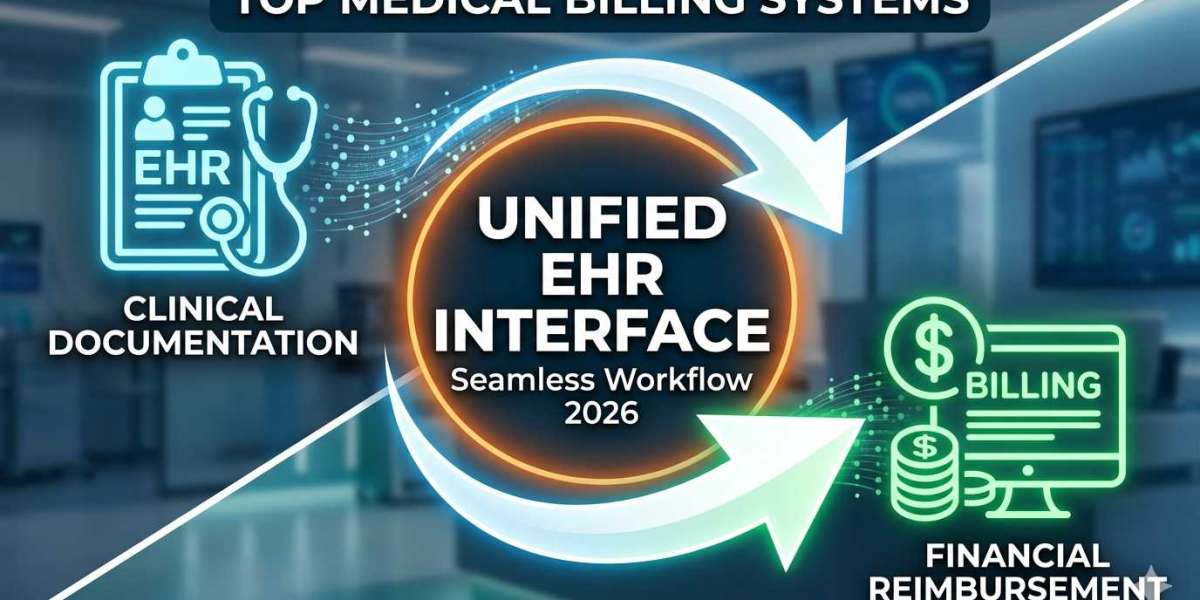

Medical billing structures with integrated digital health statistics (EHR) combine clinical and financial facts on one platform. This integration allows healthcare professionals to manage patient statistics, coding, billing and claims in a single workflow. Instead of using separate structures, integrated solutions reduce errors, shorten acquisition times and increase charge cycles. In today's healthcare, seamless workflow is essential to ensure efficient patient care and accurate revenue management.
1. Why Integration Between EHR and Billing Matters
In traditional systems, healthcare professionals often use their own structures for scientific documentation and invoicing. This leads to delays because personnel must manually transfer data between systems. Manual access increases the potential for errors, including inaccurate patient records or coding errors.
Integrated EHR and billing structures solve this problem through robotic sharing of records. When a doctor completes an affected person's documentation, the gadget can instantly generate billing codes and claims. This reduces duplication of effort and improves accuracy.
Studies show that integrated systems help reduce claim rejections and speed up refunds because information flows instantly from scientific data to billing processes.
2. Key Features of Integrated Billing Systems
A robust clinical billing unit with EHR integration includes several key features:
- Automated value access: Converts clinical notes to billable codes
- Real-time eligibility testing: instantly confirms patient insurance
- Claims management tools: track submissions, approvals and payments
- Rejected Tracking: Identifies and resolves rejected claims
- Reporting dashboard: Provides insight into sales performance
These functions work together to reduce the administrative burden and improve overall financial performance. Automation serves an important function by handling repetitive tasks and allowing employees to focus on more complex tasks.
3. Top Medical Billing Systems with Integrated EHR
Athenahealth
Athenahealth is a cloud-based tool that combines EHR, invoicing and practice management. It provides access to real-time records and automated claim scrubbing, helping to reduce pre-submission mistakes. The gadget also provides an overall performance dashboard to track economic metrics.
Epic Systems (EpicCare)
Epic is widely used in large hospitals and healthcare networks. It provides deep integration between clinical documentation and billing. The system automatically collects fees from patient records and supports full revenue cycle management.
DrChrono
DrChrono is a mobile-friendly platform that integrates EHR and invoicing in one interface. It allows providers to manage patient records, coding and claims from mobile devices. This flexibility improves workflow efficiency, especially for smaller practices.
PracticeSuite
PracticeSuite provides a scalable solution with all billing and EHR functions. It simplifies process requirements in real time and integrates with certain health systems. It is suitable for farming strategies that require flexibility.
AllegianceMD
AllegianceMD combines billing, EHR and influencer engagement tools into one platform. This includes automatic submission of claims and tracking of denials, making it easy to control the revenue cycle without changing structures.
4. Benefits of Using Integrated Systems
Improved Accuracy
When scientific data and billing information are linked, the potential for human error is greatly reduced. Accurate facts result in cleaner claims and fewer rejections.
Faster Payments
Integrated systems reduce delays in submitting declarations. Faster case processing leads to faster reimbursement.
Reduced Administrative Work
Automation relieves repetitive tasks, including information registration and declaration monitoring. This reduces the workload on the invoicing staff.
Better Decision-Making
Real-time reporting enables healthcare professionals to monitor overall performance and spot problems quickly.
Enhanced Patient Experience
Accurate billing and clear verbal exchanges increase patient consideration and pride.
5. Challenges in Implementation
While the systems involved offer many blessings, there are also some difficult situations:
- Startup fees: Setup and schooling can be expensive
- Learning curve: Employees may also need time to adapt to new systems
- Data migration: Transferring data from an old gadget can be complicated
- System compatibility: Not all structures are easily compatible
Healthcare professionals must plan carefully to overcome these challenging situations. Successful implementation requires choosing a machine that fits your practice's length and workflow.
6. How to Choose the Right System
Choosing the right clinical billing machine with EHR integration depends on several factors:
Practice size: Smaller clinics need simpler systems, while hospitals need better platforms.
Ease of use: A user-friendly interface improves usability
Integration capability: The machine must be related to the current gear
Automation tasks: Look for AI and workflow automation
Support and training: reliable guide allows at certain times of implementation
Experts suggest focusing on long-term value rather than just cost. A well-integrated system can improve efficiency over the years and reduce operational problems. Choosing the right scientific billing module with EHR integration depends on several elements:
- Practice size: Smaller clinics want simpler systems, while hospitals require advanced structures.
- Ease of use: A consumer-friendly interface improves adoption
- Integration capability: The machine must be related to existing equipment
- Automation features: Look for AI and workflow automation
- Support and education: reliable guide enables during implementation
Experts suggest focusing on long-term payoffs rather than just costs. A properly integrated gadget can improve efficiency and reduce operational problems over the years.
Conclusion
Medical billing structures with integrated EHRs play an important role in modern healthcare. They integrate into medical and financial workflows, reducing errors and improving performance. Systems such as athenahealth, Epic and Dochrono show how integration can simplify complex strategy and guide higher revenue control. Although implementation may require additional time and money, long-term benefits include faster payments, improved accuracy, and better patient care. For healthcare professionals, adopting the supplied machine is an important step towards a greener and more reliable workflow.
FAQs
- What is an integrated EHR billing system?
It is a system that combines patient records and billing functions in one platform. - How does integration improve workflow?
It reduces manual data entry and allows automatic data sharing between systems. - Do integrated systems reduce claim denials?
Yes, they improve accuracy, which helps reduce errors and denials. - Are these systems suitable for small clinics?
Yes, many platforms offer scalable solutions for small and large practices. - Is training required for these systems?
Yes, staff need training to use the system effectively.
References (APA Format)
- eBridge RCM. (2025). Leading EHR/EMR systems that integrate with medical billing. Retrieved from https://ebridgercm.com
- Forbes Advisor. (2026). Best medical billing software. Retrieved from https://www.forbes.com
- Gitnux. (2026). Best EHR medical billing software. Retrieved from https://gitnux.org
- WiFiTalents. (2026). Best medical billing EMR software. Retrieved from https://wifitalents.com
- Redstag Labs. (2025). Top medical billing software solutions. Retrieved from https://redstaglabs.com