
Market Overview:
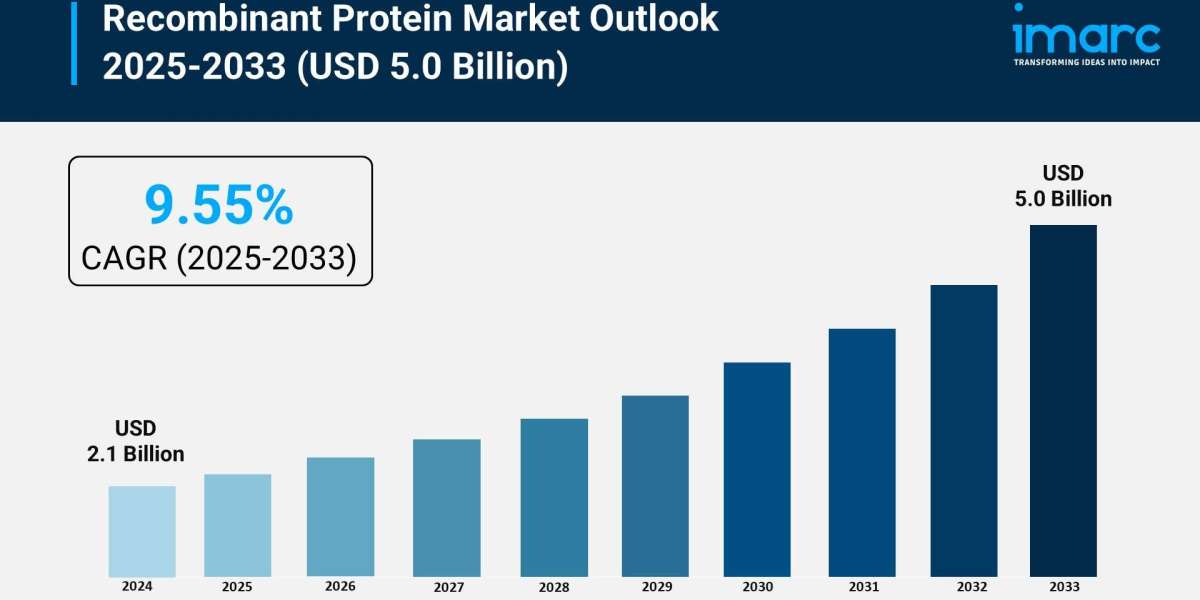
The recombinant protein market is experiencing rapid growth, driven by surge in biopharmaceutical RD and chronic disease burden, government initiatives and national biofoundry networks, and technological advancements in expression systems. According to IMARC Group's latest research publication, "Recombinant Protein Market: Global Industry Trends, Share, Size, Growth, Opportunity and Forecast 2025-2033", the global recombinant protein market size reached USD 2.1 Billion in 2024. Looking forward, IMARC Group expects the market to reach USD 5.0 Billion by 2033, exhibiting a growth rate (CAGR) of 9.55% during 2025-2033.
This detailed analysis primarily encompasses industry size, business trends, market share, key growth factors, and regional forecasts. The report offers a comprehensive overview and integrates research findings, market assessments, and data from different sources. It also includes pivotal market dynamics like drivers and challenges, while also highlighting growth opportunities, financial insights, technological improvements, emerging trends, and innovations. Besides this, the report provides regional market evaluation, along with a competitive landscape analysis.
Download a sample PDF of this report: https://www.imarcgroup.com/recombinant-protein-market/requestsample
Our report includes:
- Market Dynamics
- Market Trends and Market Outlook
- Competitive Analysis
- Industry Segmentation
- Strategic Recommendations
Growth Factors in the Recombinant Protein Market
- Surge in Biopharmaceutical RD and Chronic Disease Burden
The intensifying global burden of chronic conditions, such as cancer and autoimmune disorders, is a primary engine for market expansion. Currently, oncology treatment demands a substantial portion of the market, with the cancer therapy sector estimated to reach nearly $120 billion by the end of 2026. This demand necessitates a vast supply of recombinant proteins for drug discovery and therapeutic application. In the United States, which holds roughly a 35% share of the global market, health insurance coverage expansions and a high density of research universities are fueling a steady increase in RD spending. Major pharmaceutical entities have significantly scaled their investments; for instance, some corporations have reported RD expenditures exceeding $13 billion annually to keep pace with the need for targeted biologics. This investment translates into a denser pipeline of protein-based drugs, such as cytokines and growth factors, which are essential for treating complex metabolic and inflammatory diseases.
- Government Initiatives and National Biofoundry Networks
Strategic government funding and policy frameworks are drastically lowering barriers for biomanufacturing and research. A landmark initiative is India’s $1.1 billion investment through the SHAKTI program, launched to boost the production of biologics and recombinant protein drugs over the next five years. This includes the creation of three new national research institutes and a network of over 1,000 clinical trial sites to secure a larger global market share. Similarly, the unveiling of national biofoundry networks and the BioE3 policy in major Asian economies aims to strengthen indigenous manufacturing of "high-performance" bioproducts. These government-backed projects provide the necessary infrastructure for startups and academic institutions to scale up protein production. By subsidizing the high costs associated with recombinant DNA technology and streamlining regulatory pathways, these public initiatives ensure a continuous influx of innovative protein products into the clinical and commercial markets.
- Technological Advancements in Expression Systems
The efficiency and scalability of recombinant protein manufacturing are being transformed by breakthroughs in expression technologies and bioprocessing. Mammalian cell systems, particularly CHO (Chinese Hamster Ovary) and HEK (Human Embryonic Kidney) cells, currently dominate the market because they can perform complex post-translational modifications required for human therapeutics. To optimize these systems, researchers are increasingly utilizing CRISPR/Cas9 for "multiplexing gene-editing," which leads to significantly higher protein yields and faster development cycles. Furthermore, the integration of high-throughput screening and automated bioreactor parameters has reduced the time to market for new reagents. Real-world applications of these advancements are seen in the development of "Recombinant Protein Toolboxes"—standardized sets of specialized proteins that allow laboratories to conduct experiments with higher reproducibility. These technological leaps are making high-purity proteins more accessible for both industrial-scale drug production and foundational academic research.
Key Trends in the Recombinant Protein Market
- AI-Driven Protein Design and Production Optimization
Artificial Intelligence is no longer a peripheral tool but a central driver in the recombinant protein sector, fundamentally changing how proteins are engineered and manufactured. AI models are now routinely used to predict protein folding and stability, which dramatically reduces the failure rate in the design phase. Beyond design, machine learning algorithms are integrated into bioreactors to monitor vital parameters in real-time, making autonomous adjustments to maintain optimal growth conditions for host cells. This "smart manufacturing" trend is helping companies reduce production costs and improve batch-to-batch consistency. Current industry data suggests that AI-driven platforms can shorten the protein development timeline by months, allowing for rapid iteration of protein constructs. This trend is particularly vital for the development of personalized medicine, where proteins must be tailored to patient-specific genetic profiles with extreme precision and speed.
- Transition Toward Sustainable and Novel Bioreactors
A significant shift is occurring in how the industry sources recombinant proteins, moving beyond traditional bacterial and mammalian cells toward sustainable and cost-effective bioreactors. An emerging application of this trend is the use of insects as living bioreactors for protein synthesis. For example, recent ventures have secured millions in funding to scale up technology that utilizes silkworms to produce high-value recombinant proteins for aquaculture and therapeutic use. This approach offers a lower environmental footprint and reduced overhead compared to massive stainless-steel bioreactor facilities. Additionally, there is a growing trend toward cell-free protein synthesis, which allows for the production of proteins without the need for living cells, bypassing common toxicity issues. These novel production methods are expanding the market’s reach into emerging economies by providing localized, modular manufacturing solutions that do not require the massive infrastructure of traditional biopharma.
- Integration of Recombinant Proteins in Advanced Diagnostics
The application of recombinant proteins is rapidly expanding from purely therapeutic uses into the high-sensitivity diagnostic market. Currently, there is a rising demand for biotinylated proteins and engineered enzymes in clinical diagnostic techniques like ELISA, Western Blotting, and Immunohistochemistry. These proteins act as highly specific antigens and detection reagents, providing the sensitivity required for early-stage disease detection. For instance, the recombinant biotinylated protein segment alone is seeing increased adoption due to its superior binding efficiency in high-throughput screening. Real-world applications include the development of next-generation diagnostic kits for infectious diseases and cancer biomarkers, where recombinant antigens offer higher purity and lower cross-reactivity than animal-derived versions. This trend is bolstered by the growing global focus on timely disease detection, pushing diagnostic centers to adopt protein-based assays that offer faster and more reliable results.
Leading Companies Operating in the Global Recombinant Protein Industry:
- Abcam plc
- Amgen Inc.
- Bio-RAD Laboratories Inc.
- Bio-Techne Corporation
- Bps Bioscience Inc.
- Enzo Biochem Inc.
- Genscript Biotech Corporation
- Merck KGaA
- Novo Nordisk A/S
- ProSpec-Tany TechnoGene Ltd
- Sanofi S.A.
- Thermo Fisher Scientific
Recombinant Protein Market Report Segmentation:
By Product:
- Antibodies
- Hormones
- Growth Factors
- Cytokines
- Others
By Application:
- Drug Discovery and Development
- Academic Research
- Biotechnology Research
- Biopharmaceutical Production
- Others
By End User:
- Pharmaceutical and Biopharmaceutical Companies
- Biotechnology Companies
- Academic and Research Institutes
- Contract Research Organization
- Others
Regional Insights:
- North America (United States, Canada)
- Asia Pacific (China, Japan, India, South Korea, Australia, Indonesia, Others)
- Europe (Germany, France, United Kingdom, Italy, Spain, Russia, Others)
- Latin America (Brazil, Mexico, Others)
- Middle East and Africa
Note: If you require specific details, data, or insights that are not currently included in the scope of this report, we are happy to accommodate your request. As part of our customization service, we will gather and provide the additional information you need, tailored to your specific requirements. Please let us know your exact needs, and we will ensure the report is updated accordingly to meet your expectations.
About Us:
IMARC Group is a global management consulting firm that helps the world’s most ambitious changemakers to create a lasting impact. The company provide a comprehensive suite of market entry and expansion services. IMARC offerings include thorough market assessment, feasibility studies, company incorporation assistance, factory setup support, regulatory approvals and licensing navigation, branding, marketing and sales strategies, competitive landscape and benchmarking analyses, pricing and cost research, and procurement research.
Contact Us:
IMARC Group
134 N 4th St. Brooklyn, NY 11249, USA
Email: sales@imarcgroup.com
Tel No:(D) +91 120 433 0800
United States: +1-201971-6302