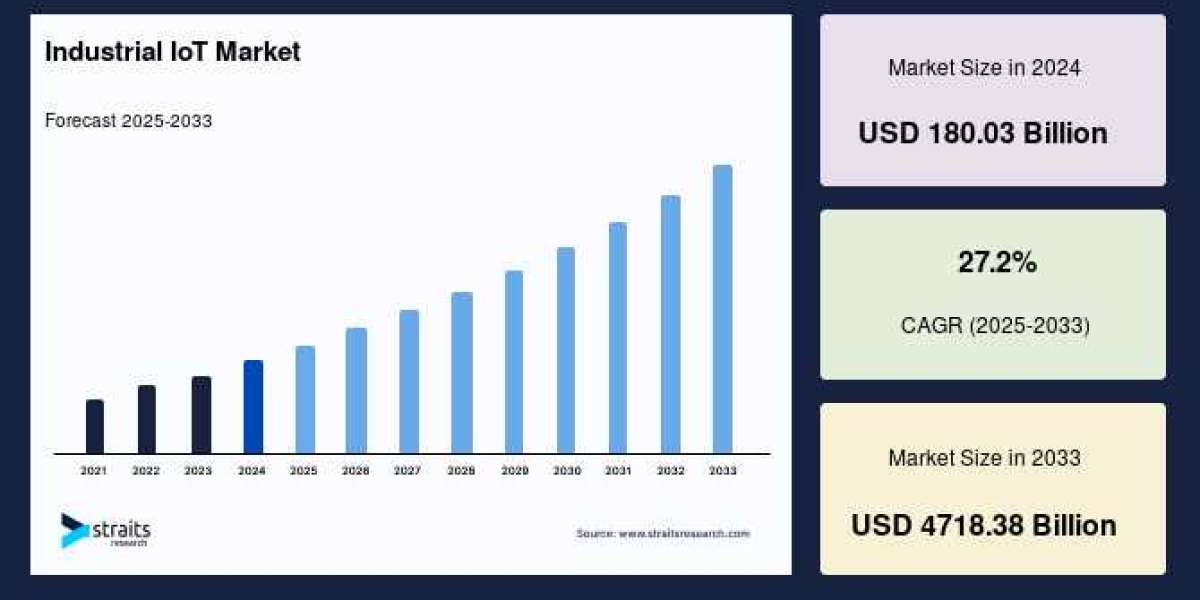

The Industrial Internet of Things (Industrial IoT or IIoT) market is transforming how industries operate by connecting machines, sensors, software, and analytics into intelligent, data-driven ecosystems. Industrial IoT enables manufacturers, utilities, energy companies, and logistics providers to improve efficiency, reduce downtime, enhance safety, and unlock new revenue streams. According to insights published by Straits Research, the Industrial IoT market is entering a phase of accelerated expansion, driven by digital transformation initiatives across industrial sectors.
Market Size 2024 – USD 180.03 billion.
Market Size 2025 – USD 243.69 billion.
Market Size 2033 – USD 4718.38 billion.
CAGR (2025–2033) – 27.2%.
These figures highlight the massive scale and long-term growth potential of the Industrial IoT market, supported by rapid adoption of automation, cloud computing, artificial intelligence, and advanced connectivity technologies.
For a detailed overview, Get Your Sample Report Here: https://straitsresearch.com/report/industrial-iot-market.
Market Overview
Industrial IoT refers to the application of IoT technologies in industrial environments such as manufacturing plants, oil and gas facilities, power generation units, transportation networks, and supply chains. IIoT solutions collect real-time data from connected devices and equipment, enabling predictive maintenance, asset tracking, energy optimization, and operational intelligence.
Straits Research indicates that industries are increasingly prioritizing IIoT investments to enhance productivity, ensure regulatory compliance, and remain competitive in a rapidly evolving global market.
To access the complete competitive analysis, Buy Report Now: https://straitsresearch.com/buy-now/industrial-iot-market.
Market Drivers
Growing Adoption of Industry 4.0
One of the primary drivers of the Industrial IoT market is the global shift toward Industry 4.0. Smart factories leverage IIoT-enabled sensors, robotics, and analytics platforms to create interconnected production systems. These systems support real-time decision-making, automation, and continuous process optimization.
Rising Demand for Predictive Maintenance
Industrial IoT solutions enable predictive maintenance by continuously monitoring equipment health and performance. This approach helps industries reduce unplanned downtime, lower maintenance costs, and extend asset life cycles, making IIoT an essential investment for capital-intensive sectors.
Expansion of Cloud and Edge Computing
The increasing availability of scalable cloud infrastructure and edge computing platforms supports the growth of the Industrial IoT market. Cloud-based IIoT solutions offer flexibility, cost efficiency, and advanced analytics capabilities, while edge computing enables low-latency data processing at the source.
Enhanced Focus on Operational Efficiency
Organizations across manufacturing, energy, and logistics are adopting IIoT to optimize workflows, reduce energy consumption, and improve overall equipment effectiveness. These efficiency gains directly contribute to improved profitability and sustainability.
For in-depth data and forecasts, Download full report https://straitsresearch.com/report/industrial-iot-market/request-sample.
Market Challenges
High Initial Implementation Costs
Despite long-term benefits, Industrial IoT adoption often requires significant upfront investments in hardware, software, integration, and workforce training. This can act as a barrier, particularly for small and medium-sized enterprises.
Data Security and Privacy Concerns
As industrial systems become increasingly connected, concerns related to cybersecurity, data breaches, and unauthorized access intensify. Protecting sensitive operational data remains a critical challenge for IIoT deployments.
Integration with Legacy Systems
Many industries operate with legacy equipment that was not designed for connectivity. Integrating such systems with modern IIoT platforms can be complex and time-consuming, slowing adoption in some sectors.
Market Segmentation Analysis
By Component
The Industrial IoT market is segmented into hardware, software, and services. Hardware includes sensors, actuators, gateways, and industrial controllers that collect and transmit data. Software platforms provide device management, analytics, and visualization capabilities, while services cover system integration, deployment, and maintenance.
By Connectivity Technology
Industrial IoT solutions rely on various connectivity technologies such as Ethernet, Wi-Fi, cellular networks, and industrial wireless protocols. The selection of connectivity depends on factors such as latency requirements, data volume, and environmental conditions.
By End-User Industry
Key end-user industries include manufacturing, energy and power, oil and gas, transportation and logistics, healthcare, and utilities. Manufacturing represents a major share of the market due to widespread adoption of smart factory concepts and automation technologies.
By Application
Applications of Industrial IoT include predictive maintenance, asset management, supply chain optimization, quality control, remote monitoring, and workforce management. Among these, predictive maintenance and asset tracking are witnessing strong demand due to their direct impact on cost savings and operational reliability.
Top Players Analysis
Based on insights from Straits Research, the Industrial IoT market features a competitive landscape with several global technology providers playing a crucial role in innovation and adoption.
Siemens AG
Siemens AG is a leading player in the Industrial IoT market, offering comprehensive digital industrial solutions. Its IIoT platforms support automation, digital twins, and advanced analytics across manufacturing and infrastructure sectors.General Electric (GE)
General Electric leverages Industrial IoT through its digital industrial solutions that focus on asset performance management, predictive analytics, and industrial software platforms for energy and manufacturing industries.Cisco Systems, Inc.
Cisco provides robust networking and connectivity solutions essential for Industrial IoT deployments. Its offerings enable secure data transmission, edge computing, and scalable industrial networks.IBM Corporation
IBM plays a key role in the Industrial IoT ecosystem with its cloud-based analytics, AI-driven insights, and enterprise-grade IIoT platforms that support data integration and operational intelligence.Honeywell International Inc.
Honeywell offers Industrial IoT solutions tailored for process industries, building automation, and industrial safety. Its focus on real-time monitoring and control systems strengthens its position in the market.
Competitive Landscape and Strategic Developments
Leading companies in the Industrial IoT market are focusing on strategic partnerships, product innovation, and platform expansion to strengthen their market presence. Investments in AI, machine learning, and edge analytics are enabling more advanced and scalable IIoT solutions.
About Us
Straits Research is a market intelligence company providing global business information reports and services. Our exclusive blend of quantitative forecasting and trends analysis provides forward