
Remote monitoring systems are increasingly common in industries, agriculture, environmental research, and public infrastructure. These systems rely on continuous data collection from sensors and devices, often located far from wired networks. A stable network connection is critical to ensure real-time data reaches centralized systems for analysis.
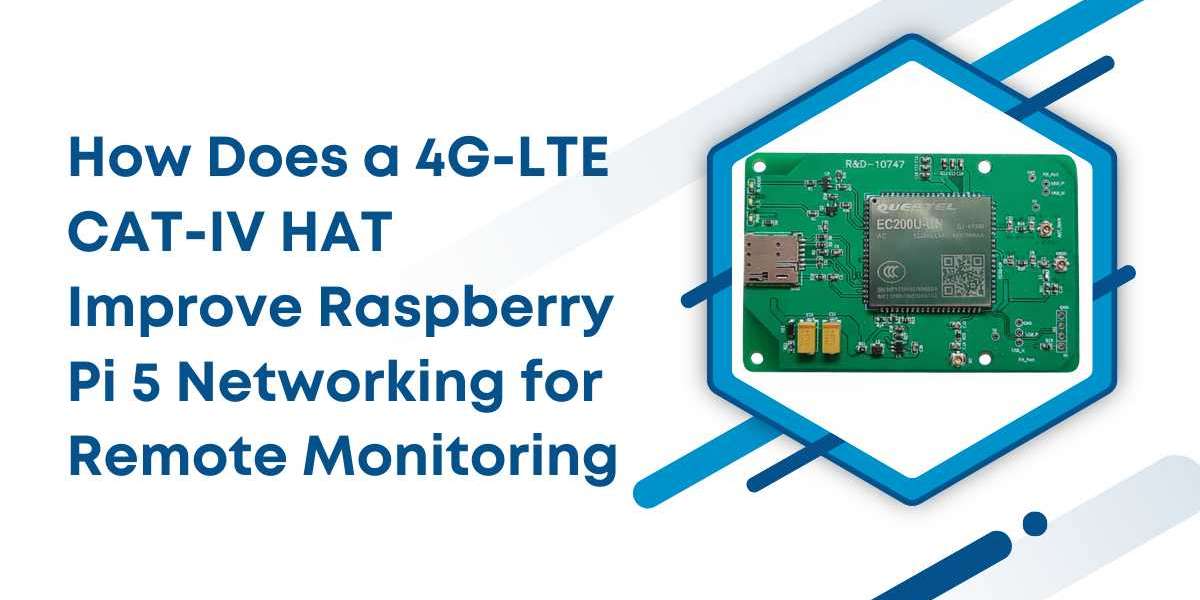
The 4G LTE CAT IV HAT for Raspberry Pi5 provides cellular connectivity, allowing devices to communicate over mobile networks instead of relying solely on Wi-Fi or Ethernet. This makes the Raspberry Pi5 CAT IV HAT ideal for remote deployments where traditional networks are unavailable or unreliable.
This article explores how a 4G-LTE CAT-IV HAT enhances networking capabilities for remote monitoring, focusing on technical aspects, real-world applications, and measurable benefits.
What is a 4G-LTE CAT-IV HAT?
A HAT, or Hardware Attached on Top, is an expansion board designed for Raspberry Pi computers. The 4G LTE CAT IV HAT for Raspberry Pi5 integrates a cellular modem, SIM card slot, and antenna connectors. It supports LTE Category 4, which allows speeds up to 150 Mbps downlink and 50 Mbps uplink under optimal conditions.
Key features of a Raspberry Pi5 CAT IV HAT include:
- Full support for LTE, 3G, and 2G fallback
- External antenna support for better signal strength
- Compatibility with Raspberry Pi 5 GPIO pins
- Standard Linux modem support through USB or UART
This HAT turns a Raspberry Pi into a mobile-ready device capable of connecting to cellular networks anywhere a SIM card provides service.
Challenges in Remote Monitoring Networking
Deploying devices in remote areas introduces several networking challenges:
1. Lack of Local Network Infrastructure
Many remote sites do not have wired or Wi-Fi networks. Installing cables is costly and time-consuming.
2. Signal Interference
Wi-Fi and other wireless signals degrade over long distances and through obstacles like walls and metal structures.
3. Mobility Needs
Some monitoring devices, such as vehicles or mobile sensors, need connectivity while moving. Fixed networks cannot meet this requirement.
4. Data Reliability
Network interruptions can lead to missing or incomplete sensor data, affecting analysis and operational decisions.
A Raspberry Pi5 CAT IV HAT addresses these challenges by using cellular networks, which offer wide coverage and consistent connectivity.
Advantages of Cellular Connectivity
1. Wide Coverage
Cellular networks cover large areas, including rural and industrial regions. This allows devices to stay connected where Wi-Fi cannot reach.
2. Reliability
Cellular networks automatically route connections through multiple towers, reducing downtime. If one tower fails, the modem switches to another automatically.
3. Signal Penetration
LTE signals penetrate obstacles better than Wi-Fi, ensuring stable connections in buildings, enclosures, and urban environments.
4. Fallback Options
The HAT supports fallback to 3G or 2G networks when LTE coverage is weak. This ensures continuous data transmission.
5. Security
SIM-based authentication and encrypted connections reduce the risk of unauthorized access. Carrier firewalls add an additional layer of security.
Technical Performance of LTE CAT-IV HAT
While remote monitoring often involves small sensor data packets, some applications require higher bandwidth, such as:
- Camera feeds from field locations
- Firmware updates for remote devices
- Large data uploads for analytics
The 4G LTE CAT IV HAT for Raspberry Pi5 provides sufficient bandwidth for these tasks. Real-world tests typically show:
- Download speeds: 10–30 Mbps
- Upload speeds: 2–15 Mbps
These speeds allow for timely data uploads, real-time monitoring, and remote software updates without reliance on local infrastructure.
Implementation on Raspberry Pi 5
Setting up a Raspberry Pi5 CAT IV HAT involves hardware installation and software configuration:
1. Hardware Setup
- Mount the HAT on the Raspberry Pi 5 GPIO header
- Connect antennas for optimal signal
- Insert an active SIM card with a data plan
2. Software Configuration
- Linux distributions such as Raspberry Pi OS support cellular modems through tools like ModemManager
- NetworkManager can manage connections and auto-reconnect
- Command-line tools like qmi or mbim allow direct control of the modem
Once configured, the Pi can maintain a persistent connection even in remote locations, automatically reconnecting if the signal drops.
Use Cases for Remote Monitoring
1. Industrial Telemetry
Factories or distributed plants use sensors to monitor equipment. LTE connections ensure continuous reporting to dashboards even if local networks fail.
2. Environmental Monitoring
Weather stations, air quality monitors, and water level sensors in remote areas require constant data uploads. Cellular connectivity eliminates reliance on local Wi-Fi.
3. Agriculture
Soil moisture, crop health, and irrigation systems benefit from LTE connections. Large fields often lack infrastructure for Wi-Fi or Ethernet.
4. Asset Tracking
Vehicles and mobile assets require real-time connectivity while moving across regions. LTE provides continuous tracking without service gaps.
5. Public Infrastructure
Streetlights, traffic sensors, and smart meters can transmit data reliably without local networking setups.
Comparison with Other Connectivity Options
Connectivity | Speed | Range | Mobility | Infrastructure |
Ethernet | Very High | Wired | No | High |
Wi-Fi | High | Short | Limited | Moderate |
LoRaWAN | Low | Very Long | Yes | Low |
NB-IoT | Very Low | Very Long | Yes | Low |
LTE Cat IV | Moderate-High | Very Long | Yes | Minimal |
LTE Cat IV balances speed and coverage, making it ideal for remote monitoring applications that require reliable data transfer and moderate bandwidth.
Deployment Considerations
1. Power Requirements
LTE modems consume high currents during transmission. Stable power sources are necessary to avoid system resets.
2. Antenna Placement
External antennas improve connectivity in weak-signal areas. Proper placement increases throughput and reduces disconnections.
3. Data Costs
Cellular plans add operational costs. Data can be optimized by batching messages or compressing transmissions.
Measurable Benefits
Using a 4G LTE CAT IV HAT for Raspberry Pi5 provides:
- Higher uptime due to reliable mobile networks
- Reduced maintenance, since devices stay connected
- Faster response times for remote troubleshooting
- Secure data transmission
Global cellular IoT connections exceeded 4 billion in 2024, showing widespread adoption for remote monitoring. About 22% of IoT devices rely on cellular networks, demonstrating reliability and scalability.
Conclusion
The Raspberry Pi5 CAT IV HAT transforms Raspberry Pi 5 into a robust edge device suitable for remote monitoring. Cellular connectivity overcomes the limitations of Wi-Fi and wired networks.
The 4G LTE CAT IV HAT for Raspberry Pi5 provides wide coverage, reliable throughput, and secure connections. Industries, agriculture, and public infrastructure benefit from consistent data flow, reduced downtime, and timely operational insights. For engineers and developers, this HAT is a practical solution for building resilient remote monitoring systems.