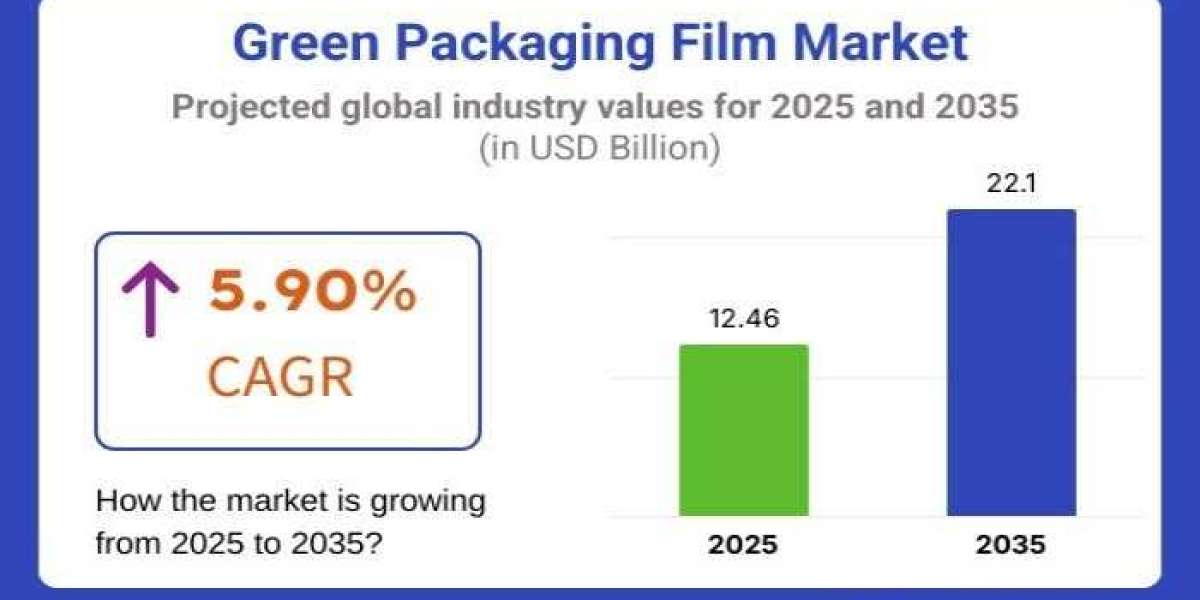

The global green packaging film market is entering a decade of strong transformation as industries, brands, and governments push toward sustainability. According to Future Market Insights (FMI), global revenue for the green packaging film industry is projected to reach USD 12.46 billion by 2025 and expand at a CAGR of 5.90% from 2025 to 2035.
By 2035, the market is expected to attain a valuation of USD 22.1 billion, driven by tightening environmental regulations, rising consumer sustainability awareness, and rapid innovation in biodegradable and recyclable film technologies.
Subscribe for Year-Round Insights → Stay ahead with quarterly and annual data updates – https://www.futuremarketinsights.com/reports/sample/rep-gb-18268
Growing Demand for Sustainable Alternatives Fuels Market Momentum
With increasing global concerns over environmental degradation, the shift from traditional plastics to recyclable, biodegradable, and compostable films is accelerating. Governments across developed and emerging economies are implementing strict rules to limit single-use plastics, compelling manufacturers to invest in eco-friendly packaging systems.
The industry is witnessing heavy adoption of mono-material film structures, plant-based polymers, and advanced recycling technologies. Consumer Packaged Goods (CPG) companies—especially in food, beverage, personal care, and e-commerce—are redesigning packaging portfolios to align with sustainability goals.
Manufacturers are also upgrading production systems with heat-sealing technologies, robotic automation, and AI-driven material optimization, allowing higher efficiency, lower waste, and stronger product performance.
Key Industry Trends Transforming the Market Landscape
A wave of structural changes is reshaping the global green packaging film market:
- Rise of Smart Transparent Packaging: Smart packaging—powered by QR codes, NFC tags, and biodegradable electronic labels—is transitioning from experimental development to mainstream usage. Companies including Johnson Johnson and leading CPG brands are integrating sensors for traceability, freshness monitoring, and waste reduction.
- Advanced Materials 3D Printed Films: The industry is rapidly shifting toward lighter, stronger, and biodegradable films, including PLA, starch blends, and plant-based composites. Innovations in 3D printing for biodegradable films are opening doors for customized, low-cost, eco-friendly solutions.
- Circular Economy Integration: Global commitments to circularity, plastic bans, and Extended Producer Responsibility (EPR) policies are compelling manufacturers to increase recycled content and adopt fully recyclable designs.
- E-Commerce Growth Fueling Demand: The global boom in e-commerce is pushing retailers and logistics companies to adopt high-strength, low-impact films that offer superior product protection while minimizing waste.
Market Dynamics: Drivers Restraints
Key Growth Drivers
- High demand for sustainable packaging (Impact: High)
- Strict government regulations on plastic waste (Impact: High)
- Advances in biodegradable materials (Impact: Medium)
- Corporate sustainability commitments (Impact: High)
- Growth in food, beverage, and e-commerce applications (Impact: Medium)
Key Restraints
- High cost of eco-friendly materials (Impact: Medium)
- Limited raw material availability
- Weak recycling infrastructure (Impact: High)
- Performance limitations in certain films (Impact: Medium)
- Resistance from plastic-dependent industries (Impact: Low)
Segment-wise Highlight
By Product Type
- Most Lucrative:
- Pouches – Strong demand in food beverage due to portion control and convenience
- Wrapping Films – Vital for food, industrial packaging, and e-commerce
- Mid-Level:
- Bags – Popular in retail but affected by reusable alternatives
- Liners – Industrial but less consumer-focused
By Material
- Most Lucrative:
- PLA (Poly Lactic Acid) – Highly compostable, regulatory support
- Starch Blends – Biodegradable, gaining traction in food packaging
- Mid-Level:
- PBAT – Flexible but requires blending
- Other plant-based materials – Emerging with limited industrial scale
By End-Use Industry
- Most Lucrative Industries:
- Food – Highest demand driven by regulations and consumer awareness
- Personal Care Cosmetics – Premium brands migrating to eco-friendly packaging
- Mid-Level:
- Beverages – Growth limited by liquid containment challenges
- Pharmaceuticals – Highly regulated adoption pace
Regional Outlook
Australia
With strict policies targeting plastic waste, Australia is expected to grow at 3.40% CAGR. Adoption is rising across food and e-commerce, supported by investments in advanced recycling.
India
India’s ban on single-use plastics and growing FMCG/e-commerce sectors are driving strong demand. Affordability and recycling gaps remain challenges, but innovation in bio-based films is accelerating.
China
China will be one of the fastest-growing markets with a 6% CAGR, backed by its circular economy goals and large-scale investment in plant-based materials.
Germany
Germany maintains leadership with a 3.60% CAGR, driven by EU directives, strong recycling infrastructure, and innovation in high-performance biodegradable films.
United States
Growing at 2.70% CAGR, the U.S. market benefits from corporate sustainability mandates, rising adoption of bio-plastics, and expanding recycling infrastructure.
Competitive Landscape
The market is highly fragmented with global giants and specialized regional players. Key companies include:
- Amcor PLC
- Mondi Group
- Berry Global Group Inc.
- Huhtamaki
- Sealed Air Corporation
- Tetra Pak
- Sonoco Products Company
- Smurfit Kappa
- UFlex Ltd.
- Constantia Flexibles
Global leaders such as Amcor, Mondi, and Berry Global continue to invest in recyclable and compostable film technologies, while emerging players accelerate adoption of plant-based and biodegradable materials.
Why FMI: https://www.futuremarketinsights.com/why-fmi
About Future Market Insights (FMI)
Future Market Insights, Inc. (FMI) is an ESOMAR-certified, ISO 9001:2015 market research and consulting organization, trusted by Fortune 500 clients and global enterprises. With operations in the U.S., UK, India, and Dubai, FMI provides data-backed insights and strategic intelligence across 30+ industries and 1200 markets worldwide.