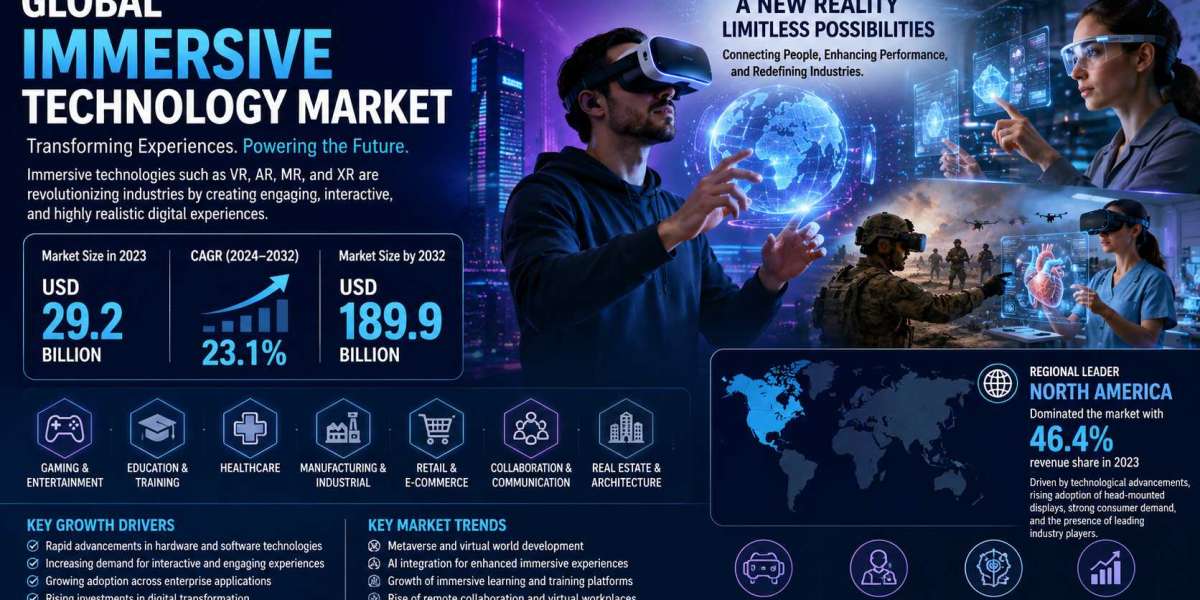

According to Dimension Market Research, The Global Immersive Technology Market is transforming the way individuals and businesses interact with digital environments. By combining technologies such as virtual reality (VR), augmented reality (AR), mixed reality (MR), extended reality (XR), and advanced simulation platforms, immersive technology is creating highly engaging experiences across industries. From gaming and entertainment to healthcare, education, manufacturing, and retail, organizations are increasingly leveraging immersive solutions to enhance user engagement, improve operational efficiency, and accelerate digital transformation.
The adoption of immersive technology has gained significant momentum in recent years due to rapid advancements in hardware, software, connectivity, and computing capabilities. Businesses are integrating immersive experiences into training programs, product visualization, remote collaboration, customer engagement, and industrial operations. As digital ecosystems continue to evolve, immersive technology is becoming a critical component of next-generation innovation strategies.
According to Dimension Market Research, the Global Immersive Technology Market is expected to reach a value of USD 29.2 billion in 2023 and is projected to grow significantly to USD 189.9 billion by 2032, registering a CAGR of 23.1% during the forecast period. This remarkable growth reflects increasing investments in digital transformation initiatives, growing demand for interactive experiences, and continuous technological advancements across multiple sectors.
Market Overview
Immersive technology refers to digital solutions that create realistic and interactive environments, enabling users to engage with virtual or augmented content in meaningful ways. These technologies bridge the gap between physical and digital worlds, providing enhanced visualization, simulation, and interaction capabilities.
The market encompasses a broad range of technologies, including virtual reality headsets, augmented reality applications, mixed reality systems, haptic devices, motion tracking solutions, and immersive software platforms. These technologies are increasingly utilized to improve learning experiences, optimize workflows, support decision-making, and create compelling customer experiences.
As organizations embrace Industry 4.0 initiatives and digital transformation strategies, immersive technologies are becoming essential tools for innovation, productivity enhancement, and competitive differentiation.
Download a Complimentary PDF Sample Report:
https://dimensionmarketresearch.com/request-sample/immersive-technology-market/
Key Market Growth Drivers
Growing Adoption of Virtual and Augmented Reality
Virtual reality and augmented reality continue to gain widespread acceptance across both consumer and enterprise applications. Businesses increasingly use these technologies for training, visualization, maintenance support, and product development.
Rising Demand for Interactive Customer Experiences
Consumers increasingly expect engaging and personalized experiences. Retailers, entertainment providers, and service organizations are leveraging immersive technology to create unique customer interactions that drive satisfaction and loyalty.
Expansion of Enterprise Applications
Industries such as manufacturing, healthcare, defense, education, and real estate are integrating immersive solutions to improve efficiency, reduce operational costs, and enhance decision-making processes.
Advancements in Hardware Technologies
Continuous innovation in head-mounted displays, smart glasses, sensors, processors, and wearable devices is improving performance, accessibility, and affordability, encouraging broader adoption.
Growth of Digital Transformation Initiatives
Organizations worldwide are investing heavily in digital technologies to improve operational agility and competitiveness. Immersive technology is emerging as a valuable tool for supporting digital transformation goals.
Emerging Market Trends
Development of the Metaverse Ecosystem
The growing interest in interconnected virtual environments is accelerating investments in immersive technologies. Businesses are exploring opportunities to create virtual workspaces, digital marketplaces, and interactive social experiences.
Integration with Artificial Intelligence
Artificial intelligence is enhancing immersive experiences by enabling real-time personalization, intelligent simulations, natural language processing, and advanced analytics.
Expansion of Immersive Learning Platforms
Educational institutions and corporate training programs increasingly utilize immersive learning environments to improve knowledge retention, engagement, and practical skill development.
Rise of Remote Collaboration Solutions
Remote and hybrid work models are driving demand for immersive collaboration tools that facilitate virtual meetings, team interactions, and project management within digital environments.
Growth of Healthcare Applications
Healthcare providers are utilizing immersive technology for medical training, surgical planning, rehabilitation, patient education, and mental health treatments.
Market Segmentation Analysis
By Technology
Virtual Reality (VR)
Virtual reality remains one of the largest segments within the market. VR solutions create fully immersive digital environments that enable users to interact with virtual content in real time.
Augmented Reality (AR)
Augmented reality overlays digital information onto physical environments, providing enhanced user experiences across retail, healthcare, education, and industrial applications.
Mixed Reality (MR)
Mixed reality combines physical and virtual elements, enabling users to interact seamlessly with both environments simultaneously.
Extended Reality (XR)
Extended reality serves as an umbrella term encompassing VR, AR, and MR technologies, offering integrated immersive experiences.
By Component
Hardware
Hardware components include headsets, smart glasses, sensors, controllers, cameras, and haptic devices that support immersive experiences.
Software
Software platforms enable content creation, simulation, visualization, application development, and immersive environment management.
Services
Professional services, consulting, implementation, maintenance, and support contribute significantly to market growth.
By Application
Gaming and Entertainment
The gaming and entertainment industry remains a major adopter of immersive technology, creating highly engaging digital experiences for users.
Healthcare
Immersive technology is improving medical education, patient treatment, therapy programs, and surgical planning processes.
Education and Training
Educational institutions and corporate organizations increasingly utilize immersive learning environments to enhance engagement and knowledge retention.
Manufacturing
Manufacturers employ immersive technologies for design visualization, workforce training, maintenance support, and production optimization.
Retail and E-Commerce
Retailers use immersive solutions to enhance customer engagement through virtual product demonstrations, interactive shopping experiences, and virtual showrooms.
Challenges Impacting Market Growth
High Initial Investment Costs
Implementing immersive technology solutions often requires significant investments in hardware, software, infrastructure, and content development.
Technical Complexity
Organizations may face challenges related to system integration, content creation, scalability, and user adoption.
Privacy and Security Concerns
The collection and processing of user data within immersive environments raise concerns regarding privacy, cybersecurity, and regulatory compliance.
Limited Content Availability
Although content libraries continue to expand, certain sectors still face limitations in industry-specific immersive applications and experiences.
Competitive Landscape
The Immersive Technology Market remains highly competitive and innovation-driven. Market participants focus on developing advanced hardware solutions, expanding software capabilities, and creating industry-specific applications.
Strategic partnerships, acquisitions, research initiatives, and ecosystem development are common approaches used to strengthen market positions. Companies are also investing in artificial intelligence, cloud computing, and next-generation connectivity technologies to enhance immersive experiences.
Purchase the report for comprehensive details:
https://dimensionmarketresearch.com/checkout/immersive-technology-market/
Regional Analysis
North America
North America dominated the Immersive Technology Market in 2023, accounting for approximately 46.4% of total revenue. The region benefits from advanced technological infrastructure, strong investment activity, and widespread consumer adoption of immersive solutions. The growing demand for head-mounted displays, coupled with the presence of leading technology companies, continues to drive significant market growth. The United States remains a major contributor to revenue generation due to its strong innovation ecosystem and increasing enterprise adoption of immersive technologies.
Europe
Europe represents a substantial market driven by technological innovation, digital transformation initiatives, and increasing adoption across healthcare, education, and industrial sectors.
Asia-Pacific
Asia-Pacific is expected to witness the fastest growth during the forecast period. Rapid technological advancements, increasing smartphone penetration, expanding gaming industries, and growing investments in digital infrastructure are supporting regional market expansion.
Latin America
The region is gradually adopting immersive technologies across education, entertainment, and retail sectors, creating new growth opportunities.
Middle East Africa
Rising investments in smart city projects, digital transformation initiatives, and advanced technology adoption are contributing to market growth across the region.
Future Outlook
The future of the Global Immersive Technology Market appears exceptionally promising. Continued advancements in virtual reality, augmented reality, mixed reality, artificial intelligence, and connectivity technologies will drive broader adoption across industries.
The emergence of metaverse platforms, increasing demand for digital collaboration, and expanding enterprise applications will create substantial growth opportunities over the coming years. As hardware becomes more affordable and software capabilities continue to improve, immersive technology is expected to become an integral component of business operations and consumer experiences worldwide.
Organizations that invest in innovation, ecosystem development, and user-centric solutions are likely to gain significant competitive advantages as the market continues to evolve.
Frequently Asked Questions (FAQs)
1. What is immersive technology?
Immersive technology refers to digital solutions such as virtual reality, augmented reality, mixed reality, and extended reality that create interactive and engaging user experiences.
2. How large is the Immersive Technology Market expected to become?
The market is projected to grow from USD 29.2 billion in 2023 to USD 189.9 billion by 2032.
3. Which industries are major users of immersive technology?
Key industries include gaming, entertainment, healthcare, education, manufacturing, retail, defense, and real estate.
4. Why is North America leading the market?
North America benefits from advanced technology infrastructure, high consumer adoption rates, strong investments, and the presence of major industry players.
5. What are the major trends shaping the market?
Key trends include metaverse development, AI integration, immersive learning platforms, remote collaboration tools, and expanding healthcare applications.
Summary of Key Insights
The Global Immersive Technology Market is poised for extraordinary growth, expanding from USD 29.2 billion in 2023 to USD 189.9 billion by 2032 at a CAGR of 23.1%. Rising adoption of virtual reality, augmented reality, mixed reality, and enterprise-focused immersive solutions is transforming industries worldwide. North America currently leads the market with a 46.4% revenue share, while Asia-Pacific is expected to experience rapid expansion. Continued technological innovation, digital transformation initiatives, and growing demand for interactive experiences will remain the primary growth drivers throughout the forecast period.