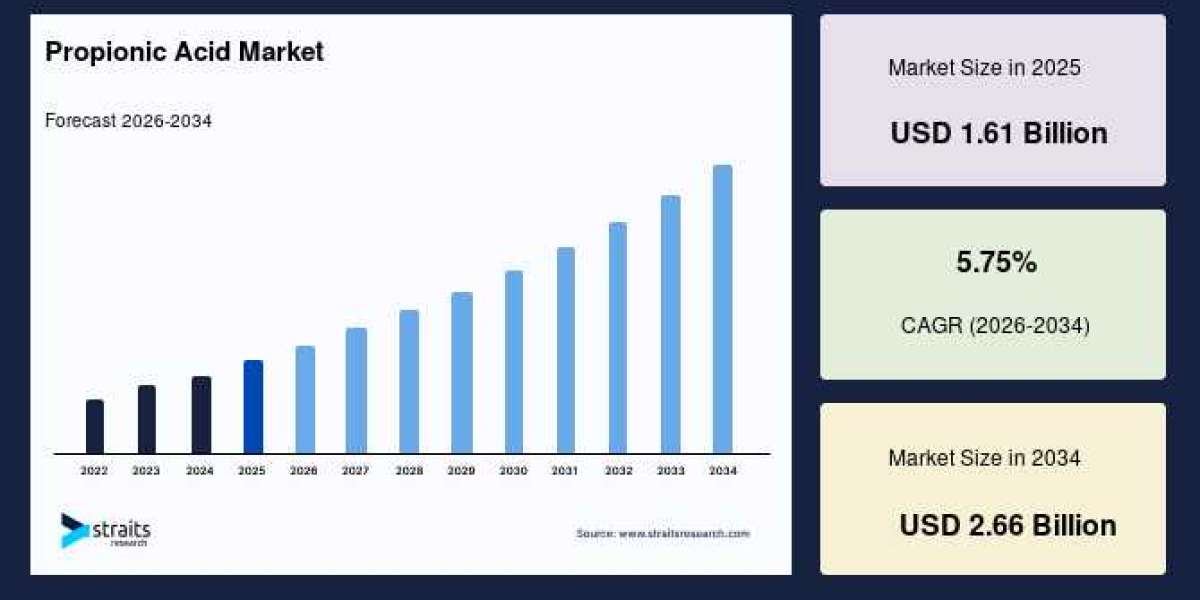

The global Propionic Acid Market is experiencing robust growth due to increasing demand from the food and beverage, animal feed, pharmaceutical, and chemical industries. Propionic acid is a naturally occurring carboxylic acid widely used as a preservative, antimicrobial agent, and chemical intermediate. Its effectiveness in preventing mold growth and extending product shelf life has made it an essential ingredient in food preservation and livestock nutrition applications worldwide.
The global propionic acid market is witnessing steady expansion as industries increasingly prioritize food safety, quality assurance, and sustainable production practices. Growing awareness regarding food preservation, rising consumption of processed foods, and increasing demand for high-quality animal feed are major factors driving market growth. Furthermore, advancements in chemical manufacturing processes and expanding applications across various industrial sectors are expected to create significant opportunities throughout the forecast period.
Market Drivers
One of the primary drivers of the propionic acid market is the growing demand for food preservatives. As global consumption of packaged and processed food products continues to rise, manufacturers are increasingly utilizing propionic acid to inhibit microbial growth and extend product shelf life. The compound is extensively used in bakery products, dairy items, and packaged foods due to its effectiveness against molds and bacteria.
The expanding livestock and animal feed industry is another major contributor to market growth. Propionic acid is widely incorporated into animal feed formulations to improve feed quality, prevent spoilage, and enhance livestock health. Rising global demand for meat, dairy, and poultry products is encouraging producers to adopt advanced feed preservation solutions, thereby increasing propionic acid consumption.
The pharmaceutical sector is also supporting market expansion. Propionic acid and its derivatives are used in the production of various pharmaceutical compounds and specialty chemicals. Growing investments in healthcare infrastructure and increasing pharmaceutical manufacturing activities are contributing positively to market demand.
Industrial applications continue to broaden as manufacturers explore new uses for propionic acid in herbicides, cellulose acetate propionate production, solvents, and chemical intermediates. The versatility of the compound makes it a valuable raw material across numerous industries.
Additionally, increasing awareness regarding food safety regulations and quality standards is encouraging manufacturers to adopt reliable preservation solutions. Regulatory compliance requirements are expected to continue driving demand for propionic acid-based products globally.
Market Challenges
Despite favorable growth prospects, the propionic acid market faces several challenges. One of the major concerns is volatility in raw material prices. Fluctuations in petrochemical feedstock costs can significantly affect production expenses and profit margins for manufacturers.
Another challenge involves stringent environmental and regulatory requirements associated with chemical manufacturing processes. Compliance with safety standards, emissions regulations, and environmental protection guidelines may increase operational costs for market participants.
The market also faces competition from alternative preservatives and antimicrobial agents. Manufacturers must continuously demonstrate the effectiveness, safety, and economic advantages of propionic acid products to maintain market competitiveness.
Furthermore, supply chain disruptions and transportation challenges may impact product availability and pricing, particularly in regions heavily dependent on imported raw materials and chemical intermediates.
Market Segmentation
The propionic acid market is segmented based on application, end-user industry, production process, and distribution channel.
By application, the market includes animal feed and grain preservation, food preservatives, herbicides, pharmaceuticals, cellulose acetate propionate, and other industrial applications. The animal feed and grain preservation segment accounts for a significant market share due to increasing demand for feed quality enhancement and spoilage prevention solutions. Food preservatives also represent a major segment as food manufacturers continue to prioritize shelf-life extension and product safety.
Based on end-user industry, the market serves food and beverage, agriculture, pharmaceuticals, chemicals, and industrial manufacturing sectors. The food and beverage industry remains a dominant contributor owing to the widespread use of propionic acid in bakery and packaged food products. The agriculture sector also plays a vital role due to growing demand for livestock nutrition and crop protection solutions.
By production process, the market includes synthetic and bio-based propionic acid. Synthetic production currently dominates the market due to established manufacturing infrastructure and cost efficiency. However, bio-based propionic acid is gaining attention as industries increasingly focus on sustainability and environmentally friendly production methods.
Based on distribution channel, the market includes direct sales, distributors, wholesalers, and online procurement platforms. Direct sales remain prominent among large industrial buyers seeking long-term supply agreements and consistent product quality.
Regional Insights
North America holds a substantial share of the global propionic acid market due to its well-established food processing industry, advanced agricultural sector, and strong pharmaceutical manufacturing capabilities. The United States remains a major contributor owing to high demand for food preservatives and animal feed additives.
Europe also represents a significant market driven by stringent food safety regulations, increasing focus on sustainable agricultural practices, and strong demand for quality food products. Countries such as Germany, France, the United Kingdom, and Italy continue to support regional growth through ongoing investments in food processing and chemical manufacturing industries.
Asia-Pacific is expected to witness the fastest growth during the forecast period. Rapid industrialization, growing population, increasing food consumption, and expanding livestock production are driving demand across countries such as China, India, Japan, and Southeast Asian nations. Rising investments in food processing facilities and agricultural modernization initiatives further support regional expansion.
Latin America is emerging as a promising market due to increasing agricultural activities and growing food production industries. Meanwhile, the Middle East Africa region is gradually adopting advanced food preservation and feed management solutions, creating new growth opportunities for market participants.
Key Players Analysis
The propionic acid market is highly competitive, with leading chemical manufacturers focusing on production capacity expansion, technological innovation, and sustainability initiatives. Companies are investing heavily in research and development to improve manufacturing efficiency, reduce environmental impact, and develop high-purity propionic acid products for specialized applications.
Strategic partnerships, mergers, acquisitions, and long-term supply agreements are common growth strategies among market participants. Manufacturers are also strengthening their distribution networks and expanding their presence in emerging economies to capitalize on growing industrial demand.
Sustainability is becoming a key competitive factor as companies increasingly explore bio-based production methods and environmentally friendly manufacturing technologies. The growing emphasis on circular economy principles and green chemistry is expected to influence future product development and investment strategies.
As demand from food preservation, animal nutrition, and industrial applications continues to rise, competition within the propionic acid market is expected to intensify throughout the forecast period. Continuous innovation and operational efficiency improvements will remain essential for maintaining market leadership.
For detailed insights, visit: https://straitsresearch.com/report/propionic-acid-market
About Us
Straits Research is a leading research and intelligence organization, specializing in research, analytics, and advisory services, along with providing business insights and research reports.
Contact Us
Email: sales@straitsresearch.com
Tel: +1 646 905 0080 (U.S.), +44 203 695 0070 (U.K.)