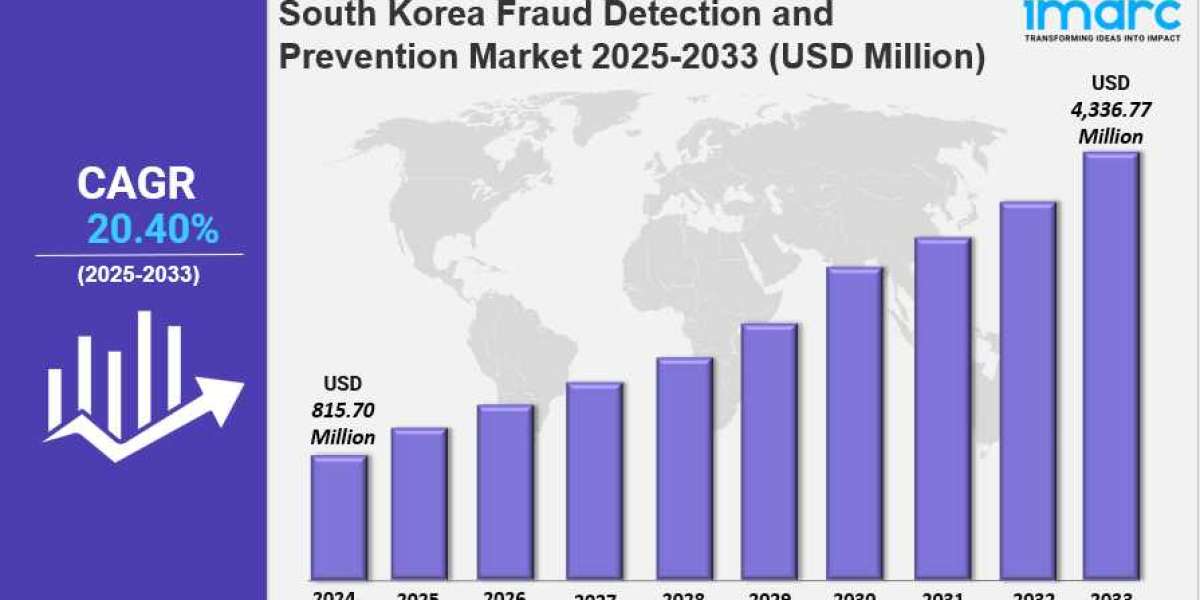

IMARC Group has recently released a new research study titled “South Korea Fraud Detection and Prevention Market Size, Share, Trends and Forecast by Component, Application, Organization Size, Vertical, and Region, 2025-2033”, offers a detailed analysis of the market drivers, segmentation, growth opportunities, trends and competitive landscape to understand the current and future market scenarios.
South Korea Fraud Detection and Prevention Market Overview
The South Korea fraud detection and prevention market size was valued at USD 815.70 Million in 2024. It is projected to expand to USD 4,336.77 Million by 2033, growing at a CAGR of 20.40% during 2025-2033. Market growth is fueled by rising financial fraud incidents, stricter regulations, and an upsurge in digital transactions. The increasing use of AI and machine learning technologies further drives market adoption alongside enhanced organizational awareness.
Study Assumption Years
- Base Year: 2024
- Historical Year/Period: 2019-2024
- Forecast Year/Period: 2025-2033
South Korea Fraud Detection and Prevention Market Key Takeaways
- Current Market Size (2024): USD 815.70 Million
- CAGR (2025-2033): 20.40%
- Forecast Period: 2025-2033
- AI and machine learning integration is revolutionizing fraud detection systems by enabling real-time data analysis and anomaly detection.
- Stringent regulatory frameworks like the Personal Information Protection Act (PIPA) are pushing organizations towards compliance and advanced fraud prevention.
- Significant fraudulent activities led to major investigations, e.g., "Operation Midas" which uncovered fake trading platforms extorting USD 6.3 Million.
- Asia-Pacific region, particularly South Korea, sees government and financial institutions adopting AI-driven cybersecurity enhancements.
- The market caters across various sectors including BFSI, government, healthcare, IT and telecom, manufacturing, retail, and e-commerce.
Sample Request Link: https://www.imarcgroup.com/south-korea-fraud-detection-prevention-market/requestsample
Market Growth Factors
The South Korea fraud detection and prevention market experiences robust growth driven by escalating financial fraud cases and rising digital transactions. Increasing incidents of fraud motivate organizations and regulatory bodies to implement stringent fraud detection solutions, evident in the rapid expansion forecasted from USD 815.70 Million in 2024 to USD 4,336.77 Million by 2033 at a CAGR of 20.40%. Enhanced surveillance and advanced fraud prevention systems are imperative in minimizing financial losses in digital commerce and banking sectors.
Artificial intelligence (AI) and machine learning (ML) significantly amplify market growth by enabling dynamic fraud detection. These technologies analyze large data streams in real-time, uncovering suspicious patterns that traditional systems might miss. South Korea’s adoption of AI-powered fraud detection is exemplified by cases such as SK Telecom’s malware incident involving 25 strains that remained undetected for nearly two years, prompting deployment of new detection systems and verification protocols. Such advancements heighten market demand for sophisticated fraud prevention services.
Regulatory pressures constitute a major market catalyst. Authorities in South Korea enforce compliance through laws such as the Personal Information Protection Act (PIPA), compelling institutions to upgrade security frameworks. High-profile crackdowns like the December 2024 "Operation Midas" demonstrated authorities’ commitment by dismantling large-scale fraud rings manipulating fake trading platforms and seizing critical infrastructure. These regulations increase the urgency for businesses—especially in BFSI, e-commerce, and telecommunications—to adopt compliant fraud mitigation technologies, further propelling market expansion.
Market Segmentation
- Component:
- Solution: Technology-based fraud detection and prevention tools designed to identify and mitigate fraud risks.
- Services: Professional support including consulting, implementation, and maintenance of fraud detection systems.
- Application:
- Identity Theft: Methods specifically countering unauthorized acquisition and use of personal identity data.
- Money Laundering: Detection systems targeting illicit financial flows and money concealment.
- Payment Fraud: Solutions devoted to identifying fraudulent payment transactions and unauthorized usage.
- Others: Additional fraud detection applications not categorized above.
- Small and Medium-sized Enterprises: Tailored fraud prevention solutions for SMEs with varied security needs and resource constraints.
- Large Enterprises: Comprehensive fraud management systems suitable for complex, large-scale operations.
- Vertical:
- BFSI: Banking, financial services, and insurance sectors implementing fraud detection to secure transactions and assets.
- Government and Defense: Public sector agencies focusing on securing sensitive information and operations.
- Healthcare: Healthcare providers safeguarding patient data and financial transactions.
- IT and Telecom: Information technology and telecommunications sectors addressing cybersecurity threats.
- Manufacturing: Industrial and manufacturing firms protecting operational and transactional data.
- Retail and E-Commerce: Retail chains and online platforms monitoring fraudulent purchases and identity misuse.
- Others: Additional industry sectors employing fraud detection technologies.
Regional Insights
The dominant region in the South Korea fraud detection and prevention market is the Seoul Capital Area. The report highlights this area along with other major regions such as Yeongnam (Southeastern Region), Honam (Southwestern Region), Hoseo (Central Region), and others. However, Seoul Capital Area typically serves as the key hub for technology adoption and financial services driving the market.
Recent Developments News
- In February 2025, South Korea’s Financial Security Institute (FSI) launched advanced AI-driven fraud detection initiatives for financial firms, including adversarial attack simulations and federated learning models promoting collaborative secured AI systems.
- In May 2024, Mastercard enhanced card fraud detection speed using generative AI technology, doubling detection rates for compromised cards and improving cybersecurity by reducing false positives and identifying at-risk merchants more quickly.
About Us
IMARC Group is a global management consulting firm that helps the world’s most ambitious changemakers to create a lasting impact. The company provide a comprehensive suite of market entry and expansion services. IMARC offerings include thorough market assessment, feasibility studies, company incorporation assistance, factory setup support, regulatory approvals and licensing navigation, branding, marketing and sales strategies, competitive landscape and benchmarking analyses, pricing and cost research, and procurement research.
Contact Us
IMARC Group,
134 N 4th St. Brooklyn, NY 11249, USA,
Email: sales@imarcgroup.com,
Tel No: (D) +91 120 433 0800,
United States: +1-201971-6302