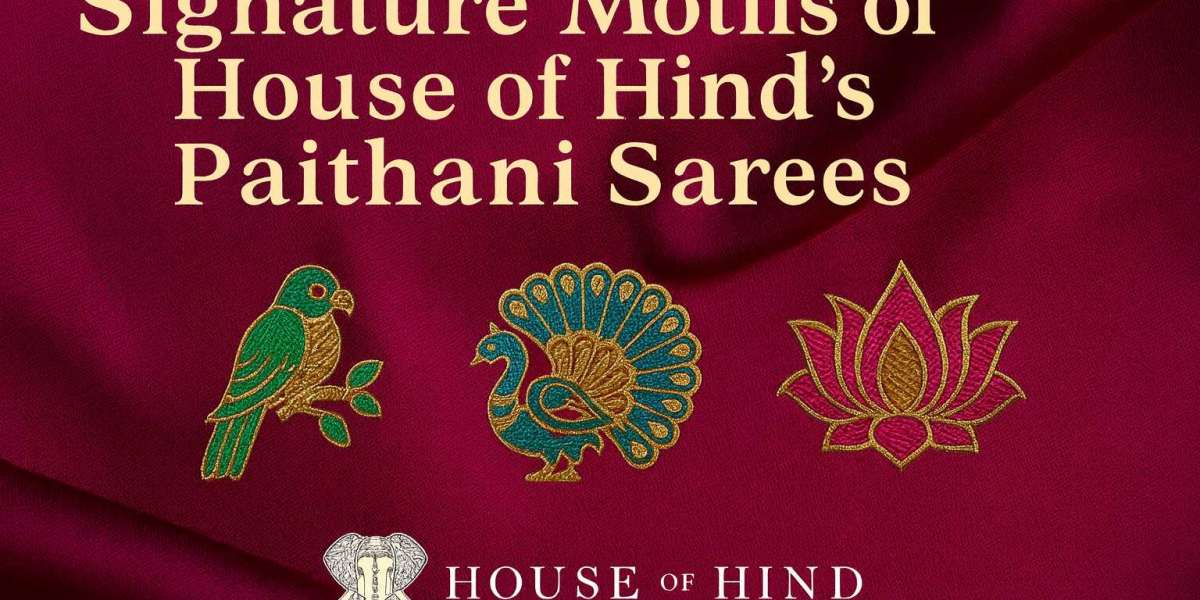

Every thread of a Paithani saree tells a story — not just of silk and zari, but of art, symbolism, and timeless craftsmanship. At House of Hind, this legacy is celebrated through designs that go beyond beauty — they narrate the language of tradition, emotion, and heritage. Among the most loved motifs in the traditional Paithani saree are the Parrot, Peacock, and Lotus — three symbols that define the very soul of this Maharashtrian treasure. As a graphic designer, exploring these motifs is like decoding a visual poetry that has been handwoven for centuries.
The Living Canvas of Paithani: A Designer’s Perspective
When you look at a Paithani saree, especially one from Yeola, it feels like gazing upon a living painting. The borders and pallu are not just ornamental; they are storytelling spaces. Each motif, color, and weave is placed with purpose — a balance of art and geometry. House of Hind preserves this essence by blending traditional weaving with modern sensibilities, ensuring that each Maharashtrian Paithani saree remains a wearable masterpiece.
From a design perspective, the beauty lies in symmetry, contrast, and symbolism. The weavers of Yeola don’t just craft patterns; they preserve philosophy through form.
The Parrot Motif: Messenger of Love and Wisdom
Among the oldest motifs in the Paithani saree, the Parrot (Tota) holds a special place. In Indian art, the parrot symbolizes affection, communication, and divine knowledge. For centuries, the parrot has been seen as the messenger between lovers or the companion of gods and goddesses.
In House of Hind’s Paithani designs, the parrot appears in multiple forms — perched gracefully on branches, paired in harmony, or facing each other near the pallu.
Design meaning and significance:
Love Companionship: Represents harmony between loved ones.
Wisdom Expression: Reflects eloquence and storytelling.
Vivid Beauty: Often woven in shades of emerald green and crimson, the parrot adds life to the saree.
The parrot’s placement on the border or pallu creates movement — almost like nature coming alive on silk. For a designer, it symbolizes freedom of imagination and the art of narration through motifs.
The Peacock Motif: Symbol of Grace and Royalty
If there is one motif that defines the grandeur of a Maharashtrian Paithani saree, it is the Peacock (Mayur). Its elegance and royal charm make it a timeless design that has adorned generations of women. The peacock stands for beauty, pride, and spiritual awakening.
The Yeola Paithani saree often showcases dual or mirrored peacocks — an exquisite representation of balance and symmetry. Each feather of zari catches light differently, giving the saree an iridescent quality that mimics the bird’s natural shimmer.
Why the Peacock Motif Stands Out:
Cultural Depth: In Indian mythology, the peacock is associated with Goddess Saraswati — symbolizing knowledge and purity.
Visual Harmony: Designers admire its graceful curves and color gradients that add dimension.
Luxury Appeal: The blend of gold zari with blue and green silk reflects sophistication and opulence.
At House of Hind, the peacock motif is often reinterpreted — using innovative color palettes while maintaining its royal spirit. It represents how tradition can gracefully evolve without losing its roots.
The Lotus Motif: A Sacred Symbol of Purity
The Lotus (Kamal) is the heart of many traditional Paithani saree designs. For centuries, the lotus has been seen as a symbol of purity, rebirth, and spiritual strength. Despite growing in mud, it blooms untouched and radiant — much like the grace of the women who wear Paithani.
In design terms, the lotus offers perfect symmetry and rhythm. The petals form beautiful radial compositions that weavers skillfully translate into intricate zari patterns.
Design insights of the Lotus Motif:
Spiritual Beauty: Reflects inner calm and purity.
Balance Growth: Its geometric form symbolizes progress and strength.
Aesthetic Harmony: Works well with both vibrant and pastel silk bases.
In House of Hind’s Paithani sarees, the lotus often appears in golden zari with subtle pink or magenta tones — evoking serenity and divine elegance.
Why Motifs Matter in the Paithani Saree Tradition
A Paithani saree is not merely a textile — it is visual storytelling woven in silk. Each motif, whether parrot, peacock, or lotus, carries layers of cultural memory. These motifs connect the wearer to India’s artistic roots and the legacy of Yeola’s handloom artistry.
From a designer’s lens, these motifs are not static patterns — they are symbols of emotion, identity, and continuity. They represent the meeting point between tradition and innovation, where every thread breathes meaning.
Highlights of Paithani Motif Artistry:
Every motif follows a geometric discipline yet maintains organic fluidity.
The color choices — rich reds, royal blues, deep greens, and golden hues — are designed to amplify the motif’s emotional tone.
The arrangement of motifs ensures visual rhythm and cultural harmony.
House of Hind: Preserving Heritage Through Modern Design
House of Hind continues to celebrate the timeless beauty of Yeola Paithani sarees by blending traditional craftsmanship with contemporary artistry. Each design is a salute to Maharashtra’s handloom legacy, ensuring the motifs remain alive and relevant for the next generation.
Their artisans maintain the authentic weaving techniques of the traditional looms while introducing subtle modern touches — refined hues, minimalist interpretations, and innovative layout styles. This approach helps keep the cultural spirit of Maharashtrian Paithani saree intact while making it appealing to today’s fashion-forward women.
Every Paithani saree from House of Hind thus becomes a celebration — not just of beauty, but of history, symbolism, and identity.
Final Reflection
The Parrot, Peacock, and Lotus motifs are not just design elements — they are the heartbeats of Paithani’s storytelling tradition. They embody love, grace, and purity, reflecting the spirit of Indian heritage. For designers and art lovers, these motifs remind us that true beauty lies not just in form, but in the meaning behind every woven thread.
House of Hind’s Paithani saree collection pays tribute to this ancient wisdom — ensuring that when you drape one, you carry a piece of India’s living art with you.